“Enough Is Enough”: Elem Kalabari Rises Against Decades of Injustice, Women Stage Peaceful Protest

By: Al Humphrey Onyanabo
For decades, Elem Kalabari has borne the burden of Nigeria’s oil wealth without tasting its benefits. Its rivers have carried crude oil to the Atlantic; its land has hosted pipelines, flow stations, and gas facilities; its people have inhaled fumes, watched their waters darken, and their livelihoods collapse.
Yet opportunity, justice, and inclusion have consistently flowed elsewhere. On Monday February 2, 2026, that long-suppressed pain found a powerful voice.
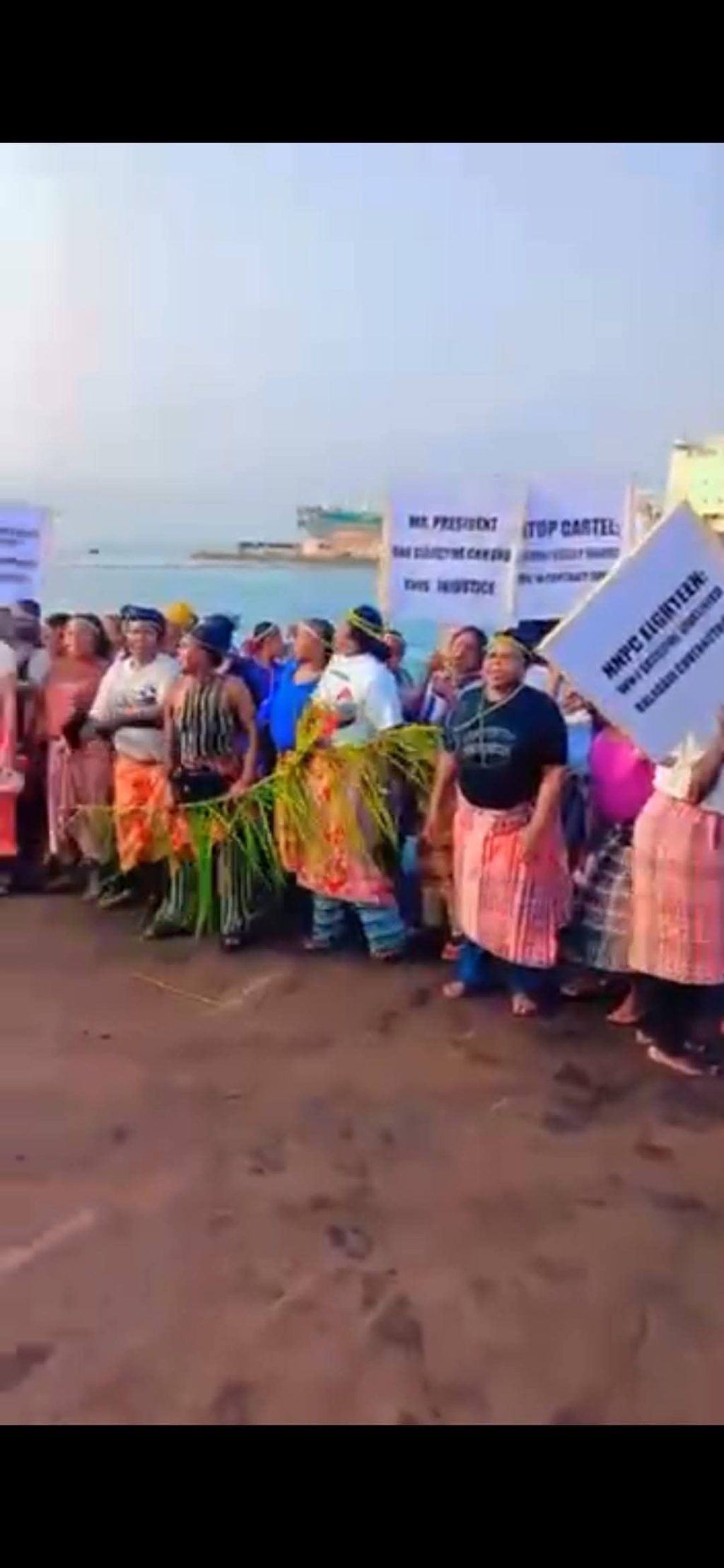
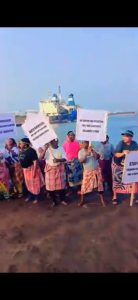
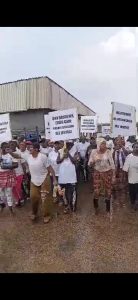
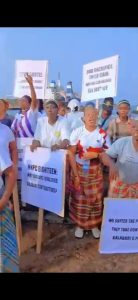
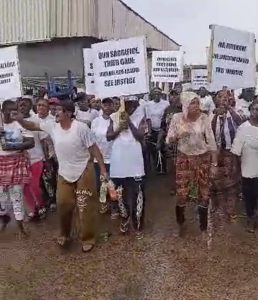
Defying a heavy morning downpour, hundreds of women from Elem Kalabari poured into the Cawthorne Channel 2 Jetty in what many now describe as the “Mother of All Protests.”
It was peaceful, disciplined, and resolute—but unmistakably firm.
This was not noise. It was a declaration. Placards told the story words alone could not fully carry: “We Carry the Burden, They Take the Benefits.”
“Our Sacrifice, Their Gain: When Will Elem-Kalabari See Justice?”
“Local Content Law Violated: Kalabari Demands First Right of Refusal.”At the heart of the protest lies a single, bitter truth: exclusion has become systemic.
A Broken Promise in OML 18
The immediate trigger was the recent award of the OML 18 pipeline security and surveillance contract by NNPC Eighteen Limited to Manton Engineering Limited—a company neither from Elem Kalabari, nor from Rivers State.
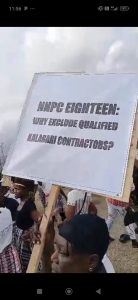
To the protesting women, this was not merely an administrative decision. It was another chapter in a long history of betrayal.
Under Nigeria’s Local Content Law and the Petroleum Industry Act, host communities are guaranteed the right of first refusal in contracts directly affecting their territory. Yet this right, the women insist, was ignored.
Even more troubling is the contradiction embedded in the law itself. Section 257(2) of the Petroleum Industry Act places responsibility for sabotage on host communities—yet when it comes to securing their own territory, those same communities are excluded. “How can a people be blamed for insecurity,” one protester asked, “and then denied the right to secure their own land?”
Rivers That Carry Wealth, Communities That Carry Pain
Elem Kalabari is not just another oil-bearing community. It is the export artery of OML 18.
Crude oil from Cawthorne Channels 1, 2, and 3, Awoba, and Krakrama is evacuated exclusively through Elem Kalabari waterways to the Atlantic Ocean. Without these rivers, there would be no barging route—no export. Yet the women revealed a staggering injustice: none of the vessels used in these daily operations belong to Elem Kalabari. None belong to Kalabari people. None even belong to Rivers State. No courtesy visits. No engagement with the Amanyanabo. No sense of obligation to the host community—despite operations generating millions of dollars daily.
“What flows through our waters enriches others,” said a woman leader “But when it comes to opportunity, our people are treated as strangers on their own land.”
Educated Children, Locked-Out Futures
Perhaps the most painful testimony came when the women spoke of their children. Many told stories of sacrifice—years of trading, fishing, and borrowing to send sons and daughters to universities—only for those graduates to return home unemployed, watching companies operate profitably on their ancestral land.
Those fortunate enough to secure employment fared little better.

Workers who had previously been full staff under the former operator, Eroton, were reportedly downgraded to contract staff under NNPC Eighteen Limited. Their pay dropped. Job security vanished.
Working conditions worsened.
In what the women described as the ultimate insult, workers allegedly brought in from Lagos were trained by these local employees—only for the trainees to be offered permanent roles, while the locals remained on contract.“It is not just unfair,” one woman said quietly. “It is humiliating.”
Environmental Destruction, Official Silence
While contracts and jobs disappear, pollution remains. Oil contamination has been reported repeatedly in Mbi-Ama, Moni-Kiri, Portuguese Kiri, and Jacob-Ama—areas affected by constant barging and operational discharge. Marine life has dwindled. Fishing yields have collapsed. Mangroves continue to die.
Reports have been filed. Complaints have been made. Yet regulatory agencies, mandated to investigate and sanction offenders, have taken little or no meaningful action. To the women, this silence feels like complicity. A First-Hand Account of Despair.
A First Encounter with Abandonment
My first visit to Elem Kalabari on 1st January, 2025 remains a haunting reminder of how thoroughly a people can be forgotten in the midst of plenty.
I visited in the company of The Amanyanabo of Elem Kalabari, Da Amakiri Tubo, Alhaji Mujahid Abubarkr Dokubo-Asari, Dabaye Amakiri 1. It was on January 1st 2025, the day after he received the staff of office from Governor Siminalayi Fubara.
What we met was not a community benefiting from decades of oil extraction, but a landscape of utter devastation, neglect, and grinding poverty.
Elem Kalabari was wrapped in darkness—total, suffocating darkness. There was no public electricity, no streetlights, not even basic solar lamps that have become commonplace in remote settlements across the Niger Delta. Night fell early, and with it came an overwhelming sense of isolation, as though the community had been cut off not only from development, but from national consciousness itself.
There were no schools to nurture young minds.
There were no clinics to tend to the sick, the pregnant, or the elderly.
There was no market, no organised economic space, no visible engine of local commerce.
What stood in place of social infrastructure was emptiness—broken structures, abandoned land, and a silence that spoke of long years of disappointment. This was a community sitting at the heart of Nigeria’s oil wealth, yet living as though the nation’s prosperity flowed around it, never through it.
It became painfully clear that the oil companies operating in and around Elem Kalabari had taken the people for granted for far too long. Their pipelines crisscross the land, their barges dominate the waterways, their wealth moves daily through Kalabari rivers—yet the human beings who bear the environmental cost have been left with nothing to show for it.
That visit stripped away any illusion. It revealed a truth the women of Elem Kalabari now proclaim with courage and clarity: neglect has become policy, and exclusion has been normalised. What we saw was not underdevelopment by accident, but abandonment by design.
And today, the people—especially the women—are saying with one voice: enough is enough.
At night sitting on the jetty, surrounded by mosquitoes in search of cellular network, I saw across the sea, vessels loading crude oil, I watched as others left. I saw the gas flares… It was a sight.
A Line Drawn in the Sand
The women have vowed to sustain their protest until justice is done. They have warned that if ignored, they will escalate actions, including shutting down operations at the flow station.
For Elem Kalabari, this moment marks a turning point.
After decades of neglect, the people are no longer whispering their pain. They are standing, together, and saying clearly—to government, to corporations, and to the nation:
Enough is enough.
There needs no telling. This is the first of many protests that will happen. The people have their backs to the wall and can’t take it no more. I can’t blame them, they have suffered for too long.
By: Al Humphrey Onyanabo,
The PEN
Tel: 08109975621
Email: Nigeria360online@gmail.com