Engr. Noimot Salako-Oyedele, FNSE: The Quiet Technocrat Redefining Political Inclusion and Governance in Ogun State
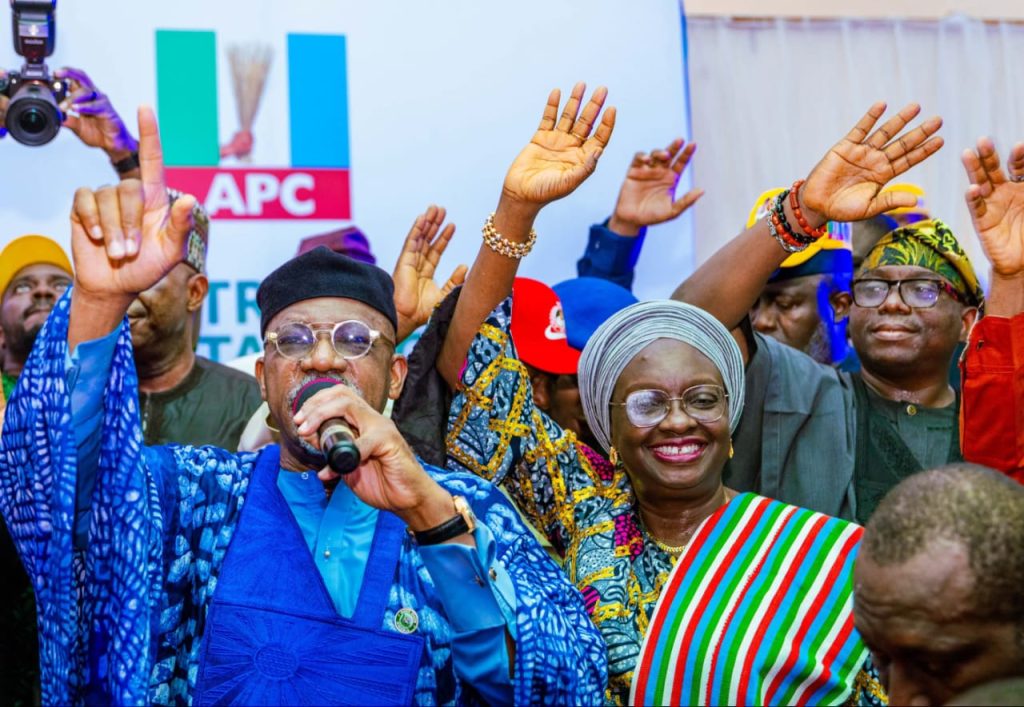

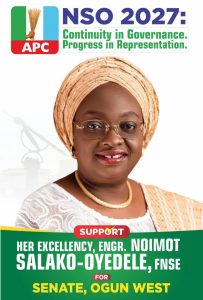
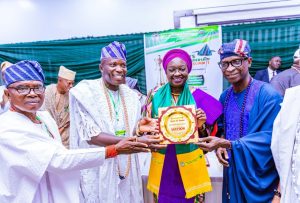
In the often turbulent landscape of Nigerian politics where loud rhetoric frequently overshadows silent performance, the rise and steady influence of Noimot Salako-Oyedele in Ogun State governance presents a different political narrative, one built on professionalism, inclusion, administrative stability and grassroots connection.
Since assuming office in May 2019 alongside Dapo Abiodun under the banner of the All Progressives Congress, Salako-Oyedele has steadily carved a reputation as one of the most influential female political figures to emerge from Ogun West and Aworiland in recent history.
Though the office of deputy governor traditionally operates within supportive and coordinating boundaries, political observers across Ogun State believe Salako-Oyedele has transformed the position into a strategic platform for governance coordination, women empowerment, human capital development and political balancing.
Her emergence in 2019 was widely viewed as a significant moment for Ogun West Senatorial District, particularly among stakeholders who had long advocated broader inclusion in the state’s political power structure. Coming from Ota in the Awori axis, her appointment strengthened the political visibility of Ogun West within state governance and helped reinforce regional confidence in the administration.

Yet beyond political symbolism, Salako-Oyedele’s years in office have increasingly been defined by policy engagement, developmental advocacy and quiet diplomacy.
One of the strongest pillars of her public service profile has remained human capital development. As Chairperson of the Nigeria for Women Project in Ogun State and Chair-in-Council of the Ogun State Human Capital Development Programme, she has championed initiatives aimed at expanding opportunities for women, youths and vulnerable citizens.
Her advocacy has consistently focused on economic inclusion, entrepreneurship support, workforce development, leadership participation for women and skills acquisition. Across various engagements, she has repeatedly encouraged greater female participation in politics and governance while emphasizing the importance of gender balance in leadership.
Her interventions have not remained at the level of speeches alone. Through empowerment initiatives and social intervention programmes, several rural women groups, cooperatives and market associations across Ogun State have benefitted from programmes linked to her office and allied agencies.
Salako-Oyedele has also continued to push for youth development through mentorship engagements, educational advocacy programmes, STEM awareness campaigns and career development initiatives targeted at young professionals. With a background in engineering and real estate, she has consistently promoted technical education, professionalism, innovation and self-development as critical pathways for national growth.

Within governance circles, many describe her as one of the stabilizing forces in the Abiodun administration. Her calm political disposition, administrative discipline and technocratic approach have helped sustain a governance style that is largely devoid of major controversies.
Her role in executive coordination has seen her represent the Ogun State Government at numerous intergovernmental meetings, budget consultations, policy dialogues and national engagements. She has also participated actively in stakeholder meetings across the divisions of Ogun State to promote inclusive governance and equitable project distribution.
President Bola Ahmed Tinubu once described her as a “consummate professional,” commending her discipline, creativity and hard work in public service, a remark that further strengthened public perception of her as a refined administrator rather than a confrontational politician.
In infrastructural and community development, Salako-Oyedele has played visible roles in educational rehabilitation projects, rural electrification interventions and advocacy for organized urban development. Her office has been linked to the commissioning of rural electrification projects in Odeda Local Government Area, including power infrastructure aimed at improving electricity access for underserved communities.
She has also participated in school rehabilitation initiatives involving classroom renovation, perimeter fencing, sanitation improvement and provision of lighting systems to improve learning environments for pupils.
Beyond physical projects, the deputy governor has remained vocal on the need for sustainable infrastructure planning, reliable power generation, digital infrastructure, sanitation systems and smart transportation development as essential drivers of industrial and economic advancement.
Her humanitarian engagements have equally contributed to her public image as a compassionate public servant. Through outreach programmes and welfare initiatives, she has supported orphanages, vulnerable children, women groups and disadvantaged citizens. One of the notable gestures linked to her office was the donation of welfare materials including deep freezers and washing machines to the Stella Obasanjo Children’s Home during a humanitarian outreach programme.
Observers within political and administrative circles also attribute several less-publicized contributions to her influence within government. These include internal conflict resolution, stakeholder engagement, executive coordination and policy advisory support on sensitive political matters.
While governance debates naturally continue within Ogun State, particularly around infrastructure challenges and developmental expectations in some areas, even critics of the administration often acknowledge Salako-Oyedele’s less combative and more professional style of politics.
To many supporters, her greatest political strength lies not in populist drama but in consistency, moderation and institution-driven leadership.
In an era where Nigerian politics is increasingly shaped by noise, polarization and personality battles, Noimot Salako-Oyedele has steadily built an alternative identity around competence, inclusiveness and administrative responsibility.
For Ogun West, women in leadership, and many young professionals watching governance from a distance, her political journey continues to represent the growing relevance of technocratic leadership in Nigeria’s democratic evolution.