Public Presentation of REDEFINING NIGERIA: Essays on State, Nation, Leadership and Democracy
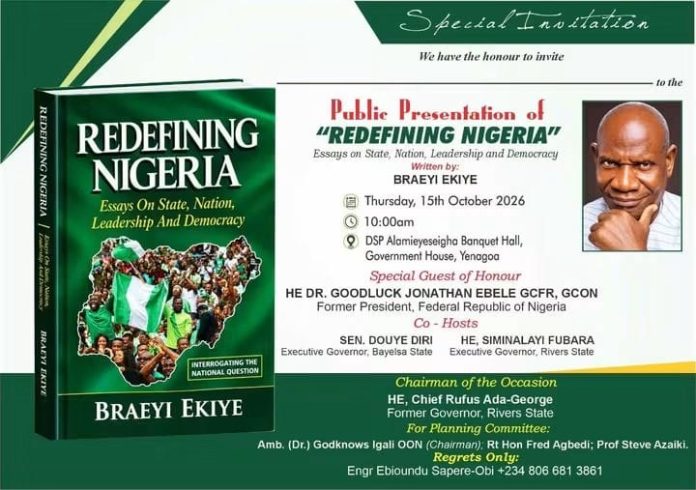

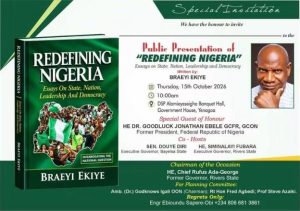
DSP Alamieyeseigha Banquet Hall, Yenagoa, Bayelsa State
Speech by Braeyi Ekiye, Author
Special Guest of Honour, His Excellency Dr. Goodluck Ebele Jonathan, GCFR, GCON, President of Nigeria (2010 to 2015)
Co-Host, His Excellency Senator Douye Diri, Executive Governor of Bayelsa State
Co-Host, His Excellency Sir Siminalayi Fubara, Executive Governor of Rivers State
Chairman of this occasion, Chief Boma Spero-Jack, Chairman, Bayelsa Elders Council Royal Father of the Day, HRM King Peremobowei Erebulu Adou III, Pere of Kabowei Kingdom
Chairman, Bayelsa State Traditional Rulers Council, King Bubaraye Dakolo Agda IV, Ibenanaowei of Ekpetiama Kingdom
Distinguished traditional rulers, respected scholars, members of the diplomatic and political community as well as members of the learned profession, journalists, fellow writers, community leaders, distinguished guests, ladies and gentlemen
I am deeply honoured to welcome you all to the public presentation of REDEFINING NIGERIA: Essays on State, Nation, Leadership and Democracy. I have read several books, written a few myself, and participated in numerous public presentations of books, particularly during my years as a publisher, editor, journalist, and speechwriter for governors. Through those experiences, I have come to understand that there are different reasons why people write. Some books are written because an author has something to say. Others are written because an author reaches a point in life when there are certain things he can no longer afford not to say. I believe Redefining Nigeria belongs to the second category.
This book is not simply a compilation of essays gathered between two covers. It is the distillation of several decades of observation, experience, journalism, public communication, questioning, and engagement with the Nigerian condition. It represents a continuing conversation I have had with our country, sometimes with admiration, sometimes with disappointment, sometimes with frustration, but always with the conviction that Nigeria is capable of becoming more than what we have so far made of it. I am therefore not simply presenting a book today. I am inviting you into a conversation with Nigeria, a conversation that I have carried for decades and that I believe must continue across generations.
My journey into this conversation was shaped profoundly by what I witnessed in the Niger Delta. I grew up observing an extraordinary contradiction that was difficult to reconcile. In communities situated close to enormous petroleum wealth, I saw people living in conditions of severe deprivation while oil workers and expatriate personnel operating nearby appeared to inhabit an entirely different economic universe. I remember travelling through towns and villages in Bayelsa, Akwa Ibom, Cross River, Ondo, Edo and Rivers State. The contrast between natural wealth and human poverty was impossible to ignore. That disparity troubled me deeply. It raised questions that have remained with me ever since: How can communities surrounded by extraordinary natural resources remain deprived of basic opportunities? Who owns the resources beneath the soil and waterways? Who determines how those resources are developed? Who receives the benefits, and who carries the environmental, health and social consequences? Those questions became more than intellectual curiosity. They became part of my personal consciousness and, over time, part of my writing.
That consciousness received a defining professional expression in early 1996 when Chief Christopher Pere Ajuwa, the first Niger Deltan to run for the office of the President asked me to undertake a documentary assignment examining the environmental condition of the Niger Delta and communicating its concerns beyond Nigeria. I spent roughly two and a half to three weeks travelling through the region, observing communities and gathering information before extending the inquiry to universities, geologists, oil and gas professionals, traditional rulers, opinion leaders, and other people whose knowledge could help me understand the complexity of the issues involved. A few months later, Bayelsa State was created, and I became part of the early communications machinery of the new state, serving as a pioneer speechwriter. My experience during that formative period deepened my understanding of the relationship between resources, political organization, public administration, and the aspirations of communities. I subsequently established Environment Watch newspaper, an environmental and general purpose tabloid. One of the major stories we pursued was the paradox of Bayelsa and the wider Niger Delta. It was titled: Poverty Sitting Upon a Sea of Wealth. That phrase was not intended as rhetoric. It captured a contradiction I had witnessed personally and one that continued to demand explanation and deep interrogation.
My professional life also gave me a long vantage point from which to observe Nigeria. I worked as a journalist, became a features editor at The Tide group, served as editor of Sunday Tide, wrote columns, worked as a publisher, and later served as a speechwriter within government for many years. Much of the journalism of that era, however, was produced before the digital systems that now make preservation and retrieval relatively easy.
As I began writing again, I became increasingly conscious that I was not only reconstructing my own intellectual history but also recovering fragments of a period in Nigeria’s public discourse that could otherwise disappear. The decision to gather these writings, therefore, became an act of recollection as well as authorship. My work with Renata Magazine in London eventually encouraged me to bring many of these ideas together, edit them, organize them thematically, and examine them afresh. That process produced this book.
The years of observation have also shaped my position on the Nigerian national question. My argument is that Nigeria must continue to examine whether its present political and economic arrangements provide sufficient room for the constituent parts of the country to develop according to their circumstances, resources, and aspirations. I have consistently advocated a more substantial form of fiscal federalism and a clearer devolution of responsibilities between the federal government and the states or other constitutionally recognized units of governance.
I believe the different regions of Nigeria possess significant agricultural, mineral, cultural, maritime, and human resources that could support stronger internal development if communities and their governments had greater responsibility for harnessing those resources, while fulfilling appropriate obligations to the wider federation. For me, this is not an argument for disintegration. It is an argument for examining whether a federation can function more effectively when responsibility, accountability, and resources are sufficiently connected. When government is closer to the people, citizens can more readily scrutinize decisions, question performance, and demand explanations. That relationship between responsibility and accountability is central to my understanding of democratic governance, capable of pummeling accelerated socio-economic growth and infrastructural transformation.
This argument is particularly compelling in the Niger Delta because the region embodies a complex convergence of economic importance, environmental degradation, political grievances, and longstanding developmental expectations. I have written extensively about oil pollution, resource ownership and control, environmental destruction, insecurity in its various forms, persistent oil theft, lack-lustre institutional interventions in the developmental process of the Niger Delta over the years, and the enduring frustration of communities that believe the wealth generated from their natural resources has not been adequately translated into improved living conditions.
The reality is considerably more complicated. My concern is that a society cannot resolve persistent structural questions by postponing them indefinitely. Silence does not eliminate a grievance, just as development projects do not automatically resolve questions of ownership, participation, accountability, or the restoration of honor and dignity in a people forcefully stripped of their God given petroleum resources. What I seek is a more mature national conversation in which competing interests can be examined honestly, in which evidence can inform public policy, and legitimate differences can be negotiated without treating disagreement as disloyalty.
This brings me to the meaning of leadership, another central concern of this book. I have spent enough time around government and public institutions to understand that political office is temporary, while the consequences of decisions can endure for generations. Leaders come and go, administrations change, political parties rise and fall, but institutions and citizens remain. Leadership should therefore be evaluated not only by speeches, ceremonies, or the immediate popularity of particular decisions, but also by what those decisions leave behind for ordinary people, the positive impact it has on them. For me, leadership carries an ethical obligation to think beyond the tenure of office. It requires the capacity to consider those who may never enter the corridors of power, those who cannot influence policy through wealth or connections, and those whose lives are affected by decisions they had no opportunity to shape. Leadership, in this sense, is not simply possession of authority. It is stewardship of consequences. I therefore, call for purposeful, selfless and incorruptible leadership to effectively drive Nigeria’s democratic and electoral process.

That understanding explains the title, Redefining Nigeria. I deliberately chose the word “redefining” because I am not calling for the abandonment of Nigeria, or the dislocation of the Nigerian state. I am asking Nigerians to reconsider how we understand the country we have inherited and how we might organize it more effectively for generations yet unborn. What does citizenship mean when opportunities remain unevenly distributed? What should be the proper relationship between federal authority and constituent governments? How should natural resources be managed? How can communities participate meaningfully in decisions that affect their lives? How can democracy become more than periodic elections and become a deeper culture of accountability, institutional integrity, participation, and public responsibility? These questions are not confined to one political party, one region, or one generation. They belong to all of us. And we must collectively find a solution to these challenges in our efforts at building a truly virile nation.
My perspective on these matters is also deeply personal. I am a Niger Deltan, but my concerns are Nigerian. I have seen the aspirations of people in Adagbabiri, Patani, Yenagoa, Port Harcourt, Torugbene, Bonny, Okrika, Bassambiri, Warri, Otuoke, Sampou and many other communities, but I have also seen that the questions confronting Nigeria extend far beyond the Niger Delta. The child in a riverine community whose school lacks basic facilities and the child in an underserved community elsewhere in Nigeria may live in different geographical circumstances, but both are asking the same fundamental question about whether the nation recognizes their potential, their capabilities and their talents. The national question, therefore, is not simply about territory or constitutional formulas. It is also about human possibility. It is about whether the Nigerian state can create conditions in which talent is not defeated by circumstance and citizenship and also not determined by geographical location.
I also believe that writers have a responsibility in this process. Patriotism should not require silence, and criticism should not automatically be interpreted as hostility. A country becomes intellectually stronger when its citizens can question its institutions without being treated as enemies of the state. My writing has therefore never been motivated by a desire to condemn Nigeria. No, not at all, It has been motivated by the belief that Nigeria is worth questioning precisely because Nigeria is worth improving. I have no interest in cultivating cynicism. This is because cynicism tells people that nothing can change. Responsible criticism, constructive in every sense of the word, does something different. It identifies what is not working, examines why it is failing, and invites society to consider alternatives. That is the spirit in which I offer this book-Redefining Nigeria.
I hope REDEFINING NIGERIA will therefore travel beyond this hall. I hope it will enter universities, classrooms, libraries, newsrooms, government offices, legislative chambers, professional associations, community meetings, and conversations, especially among young Nigerians. I hope scholars will interrogate its arguments, economists will examine its assumptions, constitutional lawyers will challenge its propositions, journalists will test its observations, policymakers will consider its implications, and citizens will bring their own experiences to the discussion. I do not expect every reader to agree with me. Indeed, I would be disappointed if a serious book produced only agreement. A worthwhile book should provoke questions. It should stimulate reflection. It should make us examine assumptions that have become so familiar that we have stopped questioning them.
I ask, therefore, Nigeria and Nigerians, and indeed, the leadership of this great country, President Ahmed Bola Tinubu, these questions: What kind of country do we want to build? What should Nigeria become, and what are we prepared to do differently to get there?. Through Redefining Nigeria, I am advocating an equitably run Nigerian state, a just and working administrative, economic and political system.
It is necessary, at this point for us to deep-seatedly and meditatively reflect on the Nigeria we have inherited, the Nigeria we experience today, and the Nigeria we still have the courage to build in-spite of its unimpressive, unjust system of governance we have had to contend with, the past 66 years since we became an independent country.
For a parting short, let us remind ourselves of the sad reflections of cerebral Alhaji Tafawa Balewa, Nigeria’s first Prime Minister on the Nigeria we inherited in 1960 at independence. And I quote: “Since the amalgamation of the Southern and Northern provinces in 1914, Nigeria has existed as one country on paper”.
Sir Tafawa Balewa then said that: “Nigeria Unity is only on British intention for the country”. Has that ‘intention’ changed for the better, the past 66years? Your answer is as good as mine.
May I end my address by insisting that a future Nigerian political leader should have the consummate will, and the audacity to restructure Nigeria in tandem with the practice of True Fiscal Federalism, and also with devolution of powers properly spelt out between the Federal Government and federating states, regions or units as the case may be. I also advocate that federating states should have rights to the ownership and control of their God given resources—Petroleum, other precious minerals, agricultural, water resources etc.
And more importantly, Nigeria’s 1999 Constitution, as amended, should be revisited and seriously interrogated. I totally agree with the former President of the Nigerian Bar Association (NBA), Barrister Wole Olalepekun (SAN), that, the National Assembly should suspend further amendments to the 1999 Military Constitution handed to Nigeria forcefully. The marathon amendments by the National Assembly to my mind, have so far been knee and surface deep, and smacks of an unimpressive, self-seeking Constitution review exercise.
As Barrister Olalepekun rightly pointed out and I quote: “This Constitution needs a new rebranding, a complete overall, a substitution altogether. It has to be a ‘negotiated’ document that will pave a way for a new social order”.
In other words, we, the people of Nigeria, should advocate for a Referendum to decide the country’s political and constitutional future for the unity, peace and security, and accelerated transformation of Nigeria.
As I stand before you today, I do not pretend that REDEFINING NIGERIA contains every answer to the questions it raises. No single book can accomplish that. What I hope it does is create intellectual movement that would instigate us to redefine Nigeria in form and purpose.
So, as I present REDEFINING NIGERIA to you, I do so with both humility and conviction. I wrote this book because I have spent decades watching, listening, questioning, recording, and reflecting. I wrote it because I have seen the extraordinary possibilities of Nigeria alongside the consequences of decisions that have not always served those possibilities. I wrote it because I believe our national conversation deserves greater intellectual seriousness, greater historical consciousness, and greater courage. Most importantly, I wrote it because I still believe the conversation is worth having.
At this junction, may I, deeply appreciate my late wife, Pastor Mrs. Lilian Ekiye, a cerebral wife of inestimable value; morally and ethically upright. My profound gratitude for her encouragement and support to my literary works during her life time. May I also particularly express my profound gratitude to members of the Book Launch Committee: Amb. (Dr.) Godknows Boladei Igali, Chairman; Rt. Hon. Dr. Fred Agbedi; Prof. Steve Azaiki; Prof. Mondy Gold; Prof. Stephen Olali, and Engr. Ebioundu Sapere-Obi. Their commitment to this occasion went beyond the formal responsibilities of organizing a book launch. They gave their time, counsel, encouragement, and personal energy to help bring this work before the public. I recognize and sincerely appreciate the confidence they placed in me and in the importance of the book-Redefining Nigeria.
I invite you, therefore, not simply to buy this book, but to read it thoughtfully. Challenge it where you disagree. Question it where you find its assumptions inadequate. Engage its arguments with evidence. Agree with it where your judgment leads you there, and disagree with it where your own reasoning takes you elsewhere. But above all, keep the conversation alive. For nations are not transformed only by the people who occupy public office. They are also transformed by citizens who think, writers who document, scholars who interrogate, communities that organize, institutions that learn, and generations that refuse to inherit yesterday’s limitations as though they were permanent laws of history.
Thank you for honouring me, thank you for honouring this book, and thank you for joining me in this continuing conversation about our beloved country, Nigeria. May God bless you all, may God bless the Niger Delta, and may God bless the Federal Republic of Nigeria.
Hon. Deacon Braeyi C. Ekiye, fcai, fmim, fabs, iap, mnipr
Publisher/CEO, Environmentwatch Communications & BRAEBI TV Services Ltd
Tel/whatsapp: +2349031594537
Email: icellimited2018@gmail.com
Date: Thursday, 15th October, 2026