
A Must Read: The penis as barometer for men’s health
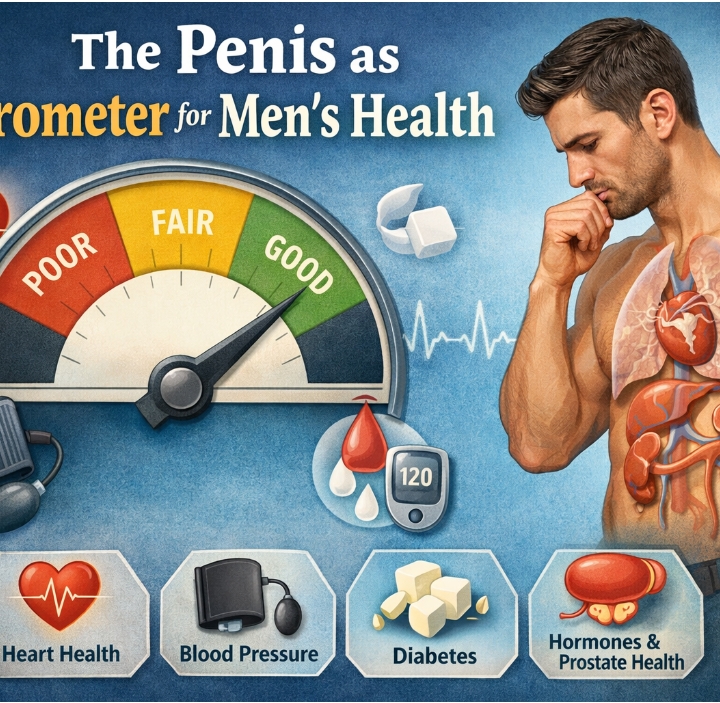

A man’s penis is a living diagnostic instrument, quietly taking notes on his vascular integrity, neurological signaling, hormonal balance, inflammatory load, metabolic health, sleep quality, and long-term survival odds. Erections are not just about desire.
Nighttime erections, in particular, are not erotic events. They are system checks. Autonomous, involuntary, and brutally honest.
When Bryan Johnson, then 48, said in 2024 that men without nocturnal erections are roughly 70 percent more likely to die prematurely, he wasn’t being provocative, he was stating what cardiology and urology have been circling for decades but nor being direct enough.
The penis predicts death because it is downstream of everything required for life to flow well.
Blood has to move freely. Nerves have to fire accurately. Nitric oxide has to be produced efficiently. Testosterone has to exist in sufficient quantity and actually be usable. Sleep cycles have to be intact. The autonomic nervous system has to be able to switch into parasympathetic mode, which means rest, repair, and regeneration. When any of those fail, erections go first, long before the heart attack, long before the stroke, long before the diagnosis that forces a man to pretend he never ignored the signs.
Penile health is not measured by whether a man can “get it up on command.” That framing is adolescent and misleading. As Dr. Ryan Welter explains, penile health includes erectile quality, orgasmic function, libido, satisfaction with intercourse, and overall sexual satisfaction.

Erectile dysfunction is not a penis problem. It is an early-warning system for cardiovascular disease. The arteries supplying the penis are significantly smaller than those feeding the heart and brain. They clog first, they lose elasticity first. Plaque buildup, insulin resistance, chronic inflammation, and endothelial dysfunction announce themselves through diminished erections years before a cardiac event.
Two to five years, on average.
When blood cannot move freely enough to produce an erection, it is already struggling elsewhere. The penis is simply the first place the system can no longer compensate. This is why pills that force blood flow without addressing root causes create the illusion of health while the underlying pathology continues to progress.
There is also a nervous system component men rarely want to face. Chronic stress, unresolved trauma, constant sympathetic activation, poor sleep, and emotional suppression all interfere with nocturnal erections. A man who never fully drops into parasympathetic repair at night is not recovering.
Libido decline follows the same pattern. Desire does not vanish randomly. It fades when energy is diverted toward managing inflammation, metabolic chaos, hormonal depletion, or psychological overload. A body under threat does not prioritize reproduction or pleasure.
This is why mocking erectile changes, dismissing them as “normal aging,” or outsourcing responsibility to pharmaceuticals is self-betrayal. The body is communicating. Loudly. Clearly. Repeatedly.
A healthy penis is proof of circulation, hormonal coherence, nervous system regulation, and metabolic resilience. It is evidence that the body can still move blood, signal nerves, generate desire, and repair itself in the dark while the mind sleeps.
When those signals disappear, the question shouldn’t be “What’s wrong with my penis?” The question should be “What is failing upstream that I don’t want to look at?”
#COPIED#